Smartphone Body Scans and the 1 cm Problem: Why Repeatability Is Not Enough
Smartphone Body Scans and the 1 cm Problem
Why repeatability is not enough when you are tracking real change
A one-centimeter change in waist circumference can be meaningful. For some people, it may represent months of consistent training, nutrition, recovery, or simply staying on course.
That creates a practical problem for any body-tracking technology:
If the method can move by one centimeter when your body has not changed, how can it tell you that a one-centimeter change is real?
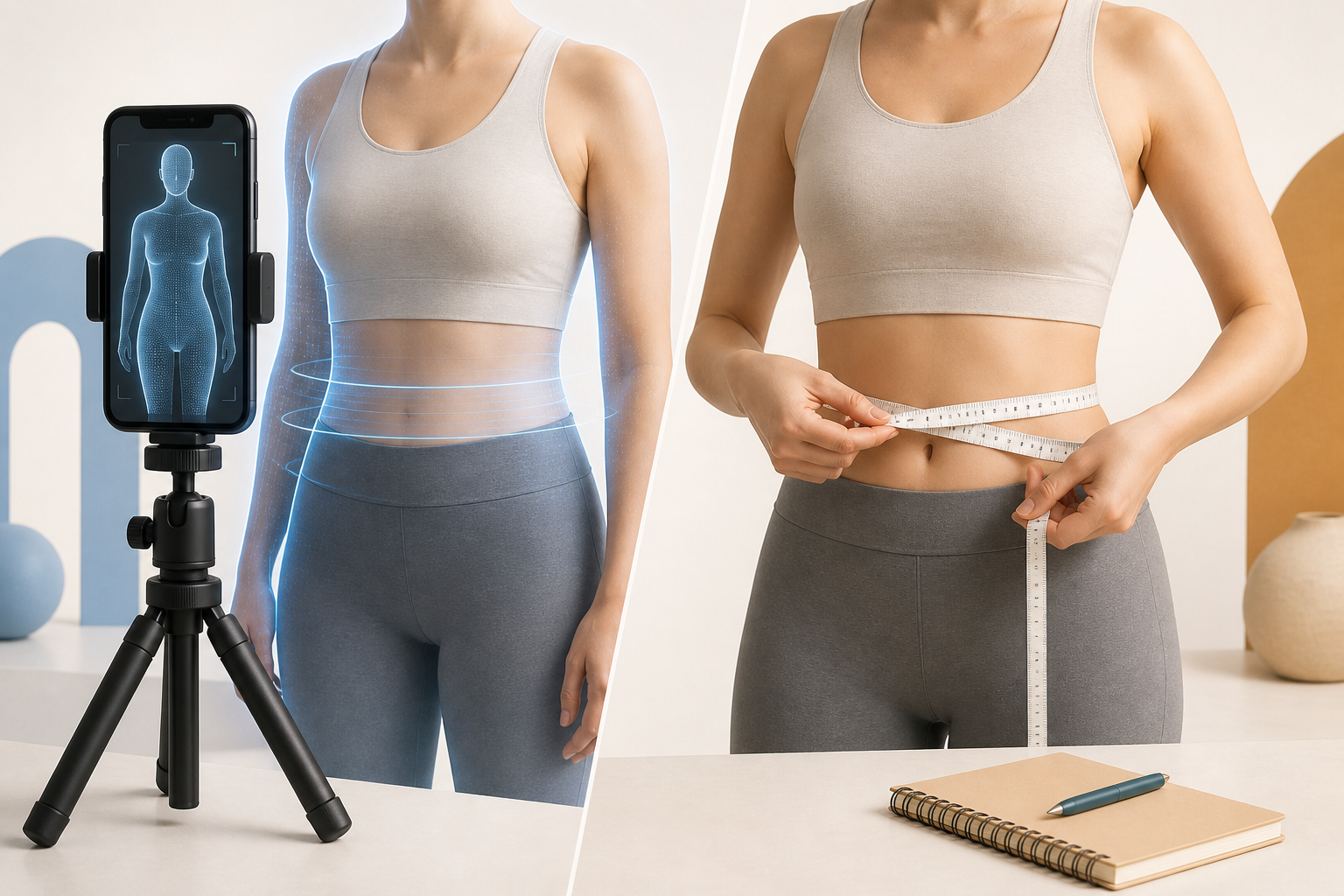
This is the question behind the recent research on smartphone-based body scanning. The research does not show that every phone scan is useless. Some modern systems can be impressively repeatable, especially when the phone is on a tripod, the room is controlled, the subject follows a strict pose, and the scan is repeated minutes apart.
But repeatability is not the same as individual accuracy. A method can produce nearly the same answer twice and still be consistently different from a tape measurement, a reference scanner, or the person’s actual body dimension. It can also be good enough to describe an average trend in a study while remaining too uncertain to confirm a small change for one person.
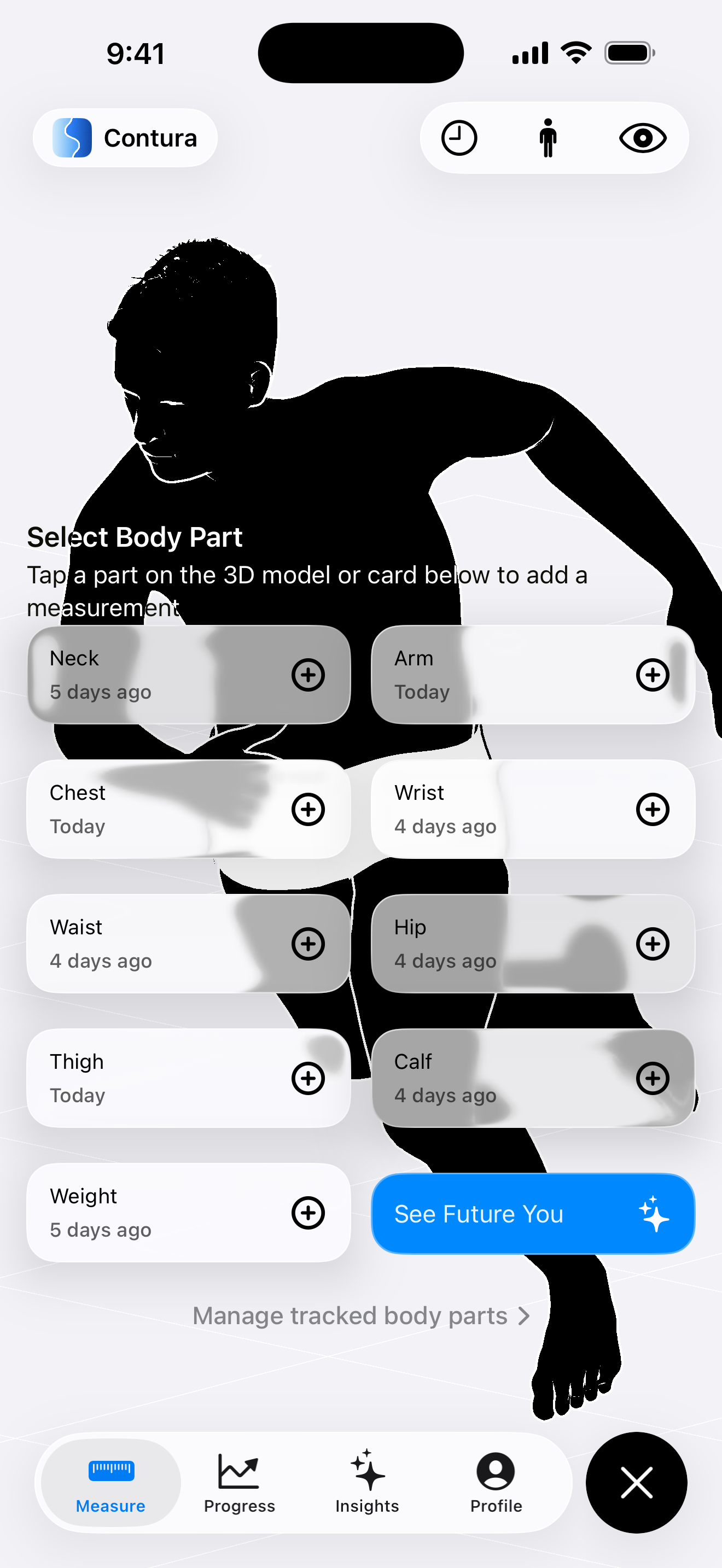
That distinction is why Contura takes a measurement-first approach: the 3D model is the way you see and compare your measurements, not a camera-generated number that silently replaces them.
Three different ideas are often mixed together
Before reading a number such as “0.5 cm error,” it helps to separate three ideas that researchers measure differently.
| Term | What it asks | Why it matters |
|---|---|---|
| Precision or repeatability | If the body has not changed, how similar are two readings? | Shows technical noise in repeated measurements. |
| Accuracy or agreement | How close is the result to a reference method? | Shows systematic bias and individual disagreement. |
| Least significant change (LSC) | How large must the difference be before it is unlikely to be measurement noise? | Sets a practical threshold for interpreting change. |
An intraclass correlation coefficient (ICC) is useful for repeatability, but a high ICC does not prove that the absolute number is correct. Correlation can also be high when one method consistently underestimates waist circumference or overestimates hip circumference.
LSC is the idea that matters most when the goal is progress tracking. In the two-measurement framework used in body-composition research, LSC is often calculated as:
LSC ≈ 2.77 × precision errorThat multiplier is why a method with a 0.5 cm precision error does not automatically let you call every 0.5 cm difference a real change.
What the best 360° smartphone research actually found
One of the strongest recent studies compared four digital anthropometry methods in 46 adults, including a smartphone application that captured serial images while the person completed a full rotation. Across circumferences, the full-rotation smartphone method had an average technical error of measurement of 0.5 cm, a relative error of 0.9%, and an ICC of 0.986. It performed similarly to larger, less portable 3D scanners in that controlled test. Tinsley et al., European Journal of Clinical Nutrition (2024)
That is a valuable result. It shows what a carefully designed 360° pipeline can achieve under repeat-test conditions.
It does not mean that:
- every scan is within 0.5 cm of your true waist circumference;
- 0.5 cm is a maximum error or a universal guarantee;
- a scan taken tomorrow in a different room, pose, outfit, or phone is equivalent to the laboratory scan; or
- a 0.5 cm difference between two personal scans is automatically real.
The related 2024 Frontiers in Medicine study makes the distinction even clearer. It used a smartphone 3D scanning application that captured many images during a complete rotation, with an iPhone mounted on a tripod about 1.7 metres from the participant. Participants maintained an A-pose, wore minimal form-fitting clothing, fasted overnight, and avoided exercise for at least 24 hours before testing. The study also notes that the body is moving during a 360° scan, so the software needs non-rigid avatar reconstruction, which can introduce additional error. Tinsley et al., Frontiers in Medicine (2024)
In that paper, the reported LSC values of 1.39–1.82 percentage points applied to body-fat-percentage equations, not to waist circumference. The paper’s 0.5 cm circumference figure was cited from the earlier full-rotation study.
As a simple illustration—not as a circumference LSC reported by that paper—if a 0.5 cm precision error were placed into the same formula, the result would be approximately:
2.77 × 0.5 cm ≈ 1.4 cmThat is the important intuition: a method can have a 0.5 cm average repeatability error while requiring a larger change before you can be confident that the change is beyond measurement noise. A one-centimeter change may be real, but it may still be too small for that method to identify confidently in one person.


The MeThreeSixty study shows why the average can be misleading
The study you referenced directly compared smartphone apps with professional tape measurements. It included 115 adults and evaluated MeThreeSixty on an iPhone and a Samsung phone, as well as myBVI. The reference waist and hip measurements were taken by investigators in a controlled laboratory protocol, not by participants casually measuring themselves at home. Graybeal et al., British Journal of Nutrition (2023)
The precision error for waist and hip circumference ranged from 0.5 to 1.9 cm. The detailed results show why that range matters:
| Method | Waist precision error | Hip precision error |
|---|---|---|
| Professional tape reference | 0.63 cm | 0.65 cm |
| MeThreeSixty on iPhone | 0.54 cm | 0.51 cm |
| MeThreeSixty on Samsung | 0.87 cm | 0.90 cm |
| MeThreeSixty across iPhone and Samsung | 1.91 cm | 1.59 cm |
| myBVI | 1.12 cm | 1.91 cm |
These are repeatability results. They do not tell us how close an app’s number is to the person’s true circumference.
When the researchers compared app results with the reference tape measurements, MeThreeSixty on the iPhone underestimated waist circumference by an average of 2.3 cm and overestimated hip circumference by an average of 3.1 cm. Across the tested apps, the 95% limits of agreement were approximately ±9.0 to ±12.4 cm for waist and ±6.7 to ±10.7 cm for hip.
The paper did find group-level equivalence for some measures within a predefined 5% region. That is not the same as proving that any individual’s result is interchangeable with a tape measurement. In fact, the small waist underestimation and hip overestimation combined to produce a waist-to-hip ratio that was not equivalent to the reference method.
This is the central lesson: a method can look acceptable when averages are compared while still producing a wide range of individual errors. If your question is “Did my waist really decrease by 1 cm?”, the individual error is more important than the group average.


Even more images do not remove the individual-level problem
A newer 2026 study compared MeThreeSixty, Bodygram, and ZOZO Fit with DXA for body-fat percentage. ZOZO Fit was the multi-image method in the comparison, using twelve photographs while the participant rotated through 360°. All three apps showed excellent same-session repeatability, with ICC values from 0.98 to 0.99. ZOZO Fit had the lowest body-fat RMSE at 2.95% and the highest concordance with DXA.
But none of the apps achieved equivalence within the study’s predefined ±2 percentage-point region. ZOZO Fit still had wide individual limits of agreement, from approximately −5.89 to +8.36 percentage points, and fewer than 44% of participants were within ±2 percentage points of DXA. The authors concluded that the apps had high repeatability but insufficient individual-level accuracy for clinical decision-making. Encarnação et al., Clinical Nutrition ESPEN (2026)
This study measured body-fat percentage rather than waist circumference, so it should not be used to claim that a particular app’s waist measurement is off by the same amount. It does, however, test the same kind of inference chain: camera images → segmentation and body model → estimated body measurements → an individual result.
The result is instructive: capturing more images can improve average model fitting without guaranteeing accurate individual change detection. More data helps, but it does not turn an inferred model output into a direct physical measurement.
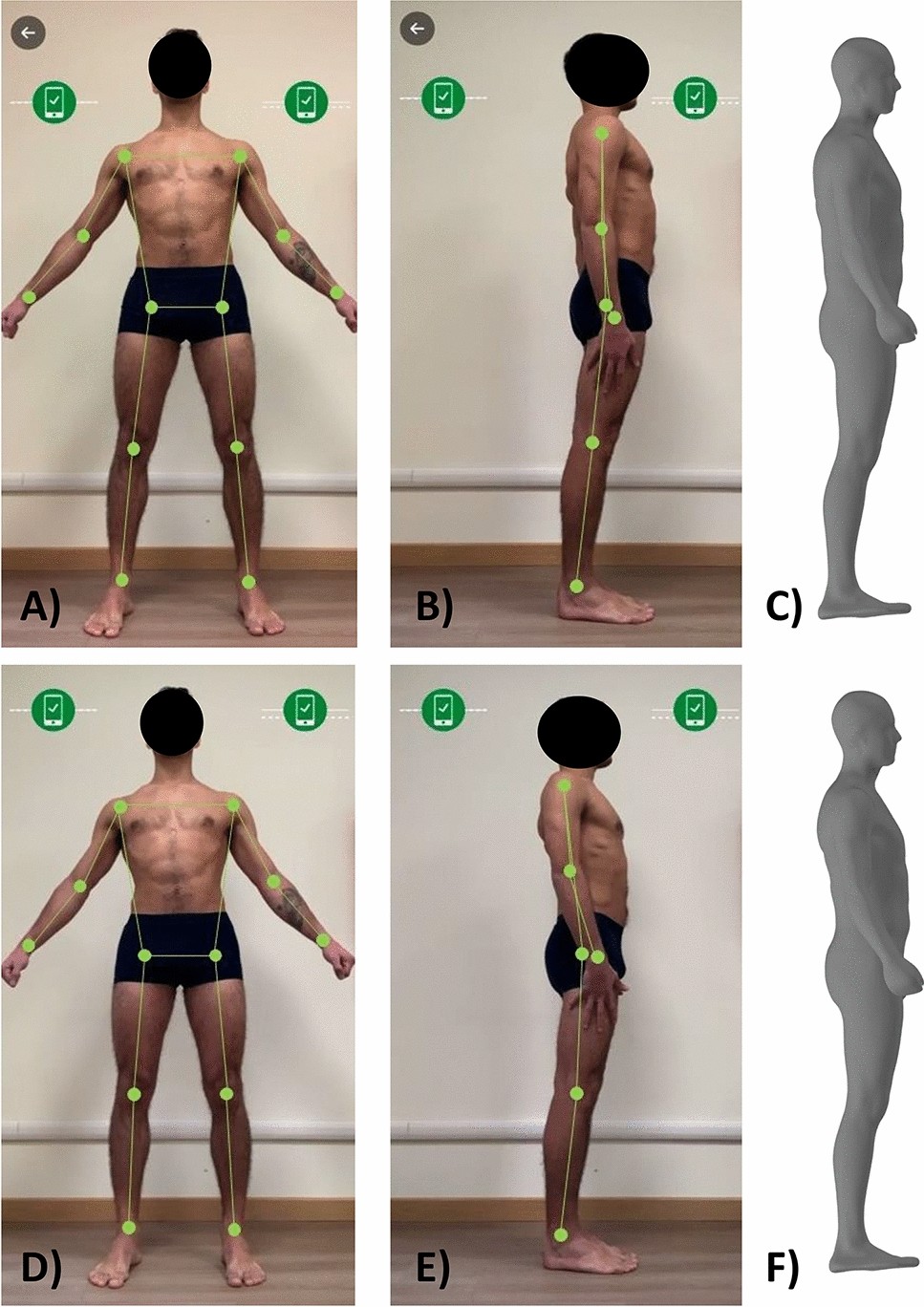
A separate open-access study shows how sensitive the reconstruction can be to pose. In one participant, changing the position of the arms during the side image changed the generated waist circumference by approximately 6 cm, even though the person’s body had not changed. This is not a claim that every phone scan will make a 6 cm error; it is a concrete demonstration that the input pose is part of the measurement system. Minetto et al., Scientific Reports (2023)
ZOZOFIT’s own help page reports a 0.4 cm margin of error, depending on the location of the measurement. That number may describe the company’s own definition, dataset, and test protocol; it should not be read as a universal 95% error bound for every body area, body type, phone, room, pose, or software version. The app’s own instructions also require a consistent position during the 360° rotation, a fixed distance from the phone, a clear background, and even lighting. ZOZOFIT: “How accurate are the ZOZOFIT measurements?” · ZOZOFIT scanning-position guidance
Why this is a structural problem, not just a software bug
A phone camera does not directly measure the circumference of your waist. It observes pixels and silhouettes, then software has to infer a three-dimensional surface, decide where an anatomical landmark is, and calculate a cross-section of the reconstructed body.
That is an inverse problem. Several different 3D shapes can produce similar 2D images, especially around soft tissue, clothing, shadows, body overlap, and regions hidden from the camera. A 360° rotation gives the algorithm much more information, but it still depends on the quality and consistency of the images and on the model used to interpret them.
The main sources of uncertainty are practical as well as mathematical:
- The landmark may not be the same landmark. Waist circumference can be measured at the iliac crest, midway between the lowest rib and the iliac crest, at the navel, or at the natural waist. These locations can produce materially different values, especially in women. Mason and Katzmarzyk, Obesity (2009)
- Posture and motion change the surface. A person turning in place is not a rigid object. The research itself describes the need to reconstruct a non-rigid avatar and normalize it to a canonical pose.
- Clothing and lighting affect the silhouette. ZOZOFIT and MeThreeSixty both provide instructions about fitted clothing, background, camera position, and lighting because the image-processing step depends on those inputs.
- The phone and software version matter. In the MeThreeSixty study, precision differed between the iPhone and Samsung implementations. Consumer apps also change their reconstruction and avatar algorithms over time.
- The training population matters. A model trained on one distribution of body shapes may behave differently for bodies with different proportions, sizes, ages, or fat distribution. The MeThreeSixty study found subgroup differences and explicitly called for more research on self-measured, at-home, and longitudinal use.
None of this means that a smartphone scan cannot be useful. It means that a scan is an estimate whose uncertainty must be considered whenever the change you care about is small.
A measuring tape is not perfect either—and that is the point
The alternative is not a magical instrument with zero error. Tape measurements also depend on the landmark, posture, breathing, tape tension, and the skill of the person measuring.
In one study of waist and hip measurements by a novice rater, the authors reported that a change greater than 3.0 cm for waist and 2.0 cm for hip could be treated as a true change with 95% confidence under their protocol. Wang et al., Perceptual and Motor Skills (2010)
The lesson is not “a tape measure is always right.” The lesson is that serious tracking requires an explicit measurement protocol. You need to know the landmark, the conditions, the method, and the size of change that the method can actually resolve.
Why Contura uses measurement-first 3D tracking
Contura is intentionally not a camera body scanner. It does not promise to infer every circumference from two photos or a 360° phone scan.
Instead, the measurement chain is visible:
| Camera-first scan | Measurement-first tracking with Contura |
|---|---|
| Body → photos → silhouette extraction → inferred 3D mesh → proprietary landmarks → measurements | Body → repeatable tape landmark → user-recorded measurement → 3D visualization → historical comparison |
| Convenient, but many hidden steps can affect the number | Slightly more deliberate, but the input can be inspected and repeated |
| The scan is the measurement | The measurement is the source; 3D is the visual output |
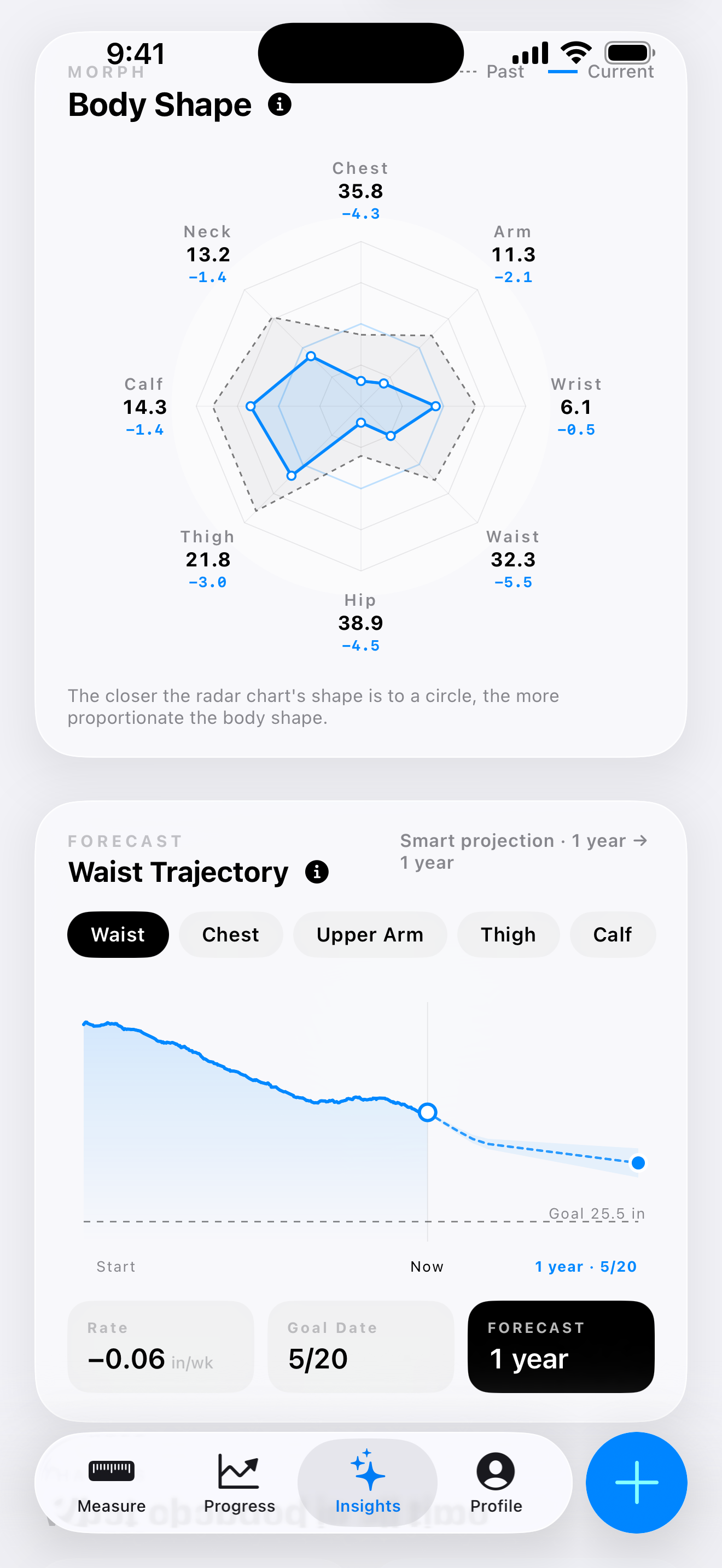
Contura helps you keep the same measurement locations in view, record multiple circumferences over time, and turn those numbers into a rotatable 3D body state. You can compare two dates and see how the measured differences translate into a consistent visual frame.
That does not make the tape measure infallible. It makes the process more transparent. If a number changes, you can ask what happened at the measurement step instead of accepting an unexplained model output. If a change is smaller than the uncertainty of one reading, you can wait for a repeated trend rather than letting a single scan decide the story.
What should you do if you are serious about tracking change?
Use a method that matches the size of the change you care about.
- Choose a clear anatomical landmark and keep it fixed.
- Measure under similar conditions: time of day, clothing, posture, breathing, and recent exercise.
- Release and reposition the tape for a second reading instead of tightening it repeatedly until the number looks right.
- Record the method along with the number.
- Look for a repeated trend across meaningful intervals, not a single daily difference.
- Treat any 3D body model—whether generated from a scan or from measurements—as a visualization, not a medical diagnosis or a perfect digital twin.
For a rough visual check or a large change, a phone scan may be convenient. But if your goal is to know whether a slow, one-centimeter change is real, do not rely on a camera scan alone. Use a measurement you can reproduce, preserve the history, and interpret the result against the method’s uncertainty.
That is the role of Contura: not to pretend that body measurement is effortless, but to make careful measurement easier to record, compare, and understand.
Explore Contura on the App Store
Frequently asked questions
Does a 0.5 cm technical error mean the scan is accurate to 0.5 cm?
No. In the 360° study, 0.5 cm was an average repeat-test technical error across circumferences under controlled conditions. It was not a maximum error, a universal guarantee, or a direct measure of agreement with your true waist circumference.
Does this mean smartphone body scanning is useless?
No. It can be useful for rough visualization, large changes, research, and some group-level applications. The evidence is simply weaker when the question is whether a small change in one individual is real.
Is Contura more accurate than MeThreeSixty or ZOZOFIT?
Contura is not making an unvalidated universal accuracy claim. It uses a different measurement model: the user records circumferences, and Contura visualizes and compares them. That makes it better suited to transparent longitudinal measurement tracking than to automatic camera-based estimation.
Is a tape measure always accurate?
No. Tape measurements need consistent landmarks and technique. Their advantage is that the measurement step is visible, teachable, and repeatable; the user can inspect and correct the method instead of accepting a hidden inference.
How often should I measure?
Most people do not need to measure every day. A schedule of every one to two weeks during fat loss, or every two to four weeks for slower body-shape changes, is often easier to keep consistent. The best interval is the one that gives the body time to change while keeping the measurement conditions comparable.
Sources and further reading
- Graybeal, Brandner, and Tinsley (2023), “Evaluation of automated anthropometrics produced by smartphone-based machine learning,” British Journal of Nutrition
- Tinsley et al. (2024), “Mobile phone applications for 3-dimensional scanning and digital anthropometry,” European Journal of Clinical Nutrition
- Tinsley et al. (2024), “Smartphone three-dimensional imaging for body composition assessment using non-rigid avatar reconstruction,” Frontiers in Medicine
- Encarnação et al. (2026), “Accuracy, repeatability, and interchangeability of smartphone-based digital anthropometry,” Clinical Nutrition ESPEN
- Minetto et al. (2023), “Equations for smartphone prediction of adiposity and appendicular lean mass in youth soccer players,” Scientific Reports
- Mason and Katzmarzyk (2009), “Variability in Waist Circumference Measurements According to Anatomic Measurement Site,” Obesity
- Wang, Liu, and Chen (2010), “Intrarater reliability and the value of real change for waist and hip circumference measures by a novice rater,” Perceptual and Motor Skills
- ZOZOFIT measurement accuracy and scan-position guidance